
In late September 2026, seven Chinese government ministries jointly released the country’s first dedicated five-year plan for the new battery industry, covering the 2026–2030 period. More than a policy document, it’s a blueprint that will shape how batteries are designed, manufactured, and deployed around the world for the rest of this decade.
For anyone working in residential energy storage, hybrid inverters, or solar-plus-storage solutions, this plan deserves your attention. Here’s what matters most.
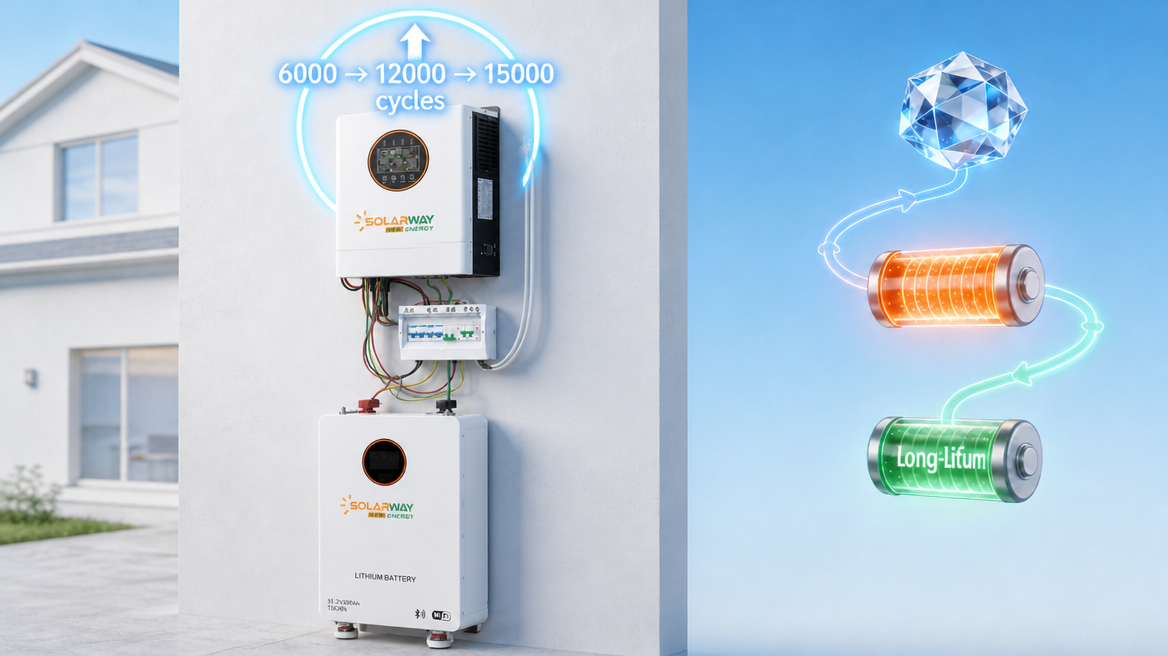
Three Technology Tracks, Each With a Clear Destination
The plan lays out three distinct technology pathways — and each one is already moving from the lab toward commercial scale:
1. Solid-State Batteries: Initial Mass Production by 2030
Solid-state batteries have been the “next big thing” for years. The 15th Five-Year Plan now gives them a concrete deadline: initial mass production by 2030. The target is ultra-high energy density — critical for electric vehicles and potentially for space-constrained storage applications. For residential storage, solid-state technology won’t replace lithium-iron-phosphate (LFP) overnight, but it signals where the industry’s innovation dollars are heading.
2. Long-Life Lithium Batteries: 15,000 Cycles and Counting
This is the track that hits closest to home — literally. The plan calls for long-life lithium batteries to reach 15,000 cycle life at the top tier. To put that in perspective, today’s premium residential lithium batteries typically deliver 6,000 to 8,000 cycles. The new target nearly doubles that.
What does 15,000 cycles mean for a home battery system? A system engineered for a 10–15 year service life could stretch to 20+ years. The total cost of ownership drops dramatically. The return-on-investment math on residential energy storage gets significantly better. And for installers and integrators, longer battery life means happier customers and stronger warranty stories.
3. Sodium-Ion Batteries: Cost-Effective Grid-Scale Deployments
The third track is sodium-ion technology, targeted at cost-sensitive grid-scale and utility storage applications. Sodium-ion batteries use abundant, low-cost materials and perform well in extreme temperatures — making them ideal for large-scale projects where energy density matters less than upfront cost and cycle stability.
Why This Matters Beyond China
You might be thinking: “This is a Chinese plan — does it affect the rest of the world?” The short answer is yes.
China is the world’s largest battery manufacturer and the biggest market for energy storage deployment. When China’s government sets technology targets, the entire global supply chain adjusts. Battery makers, material suppliers, and equipment manufacturers all invest toward the same roadmap. The result? Faster cost declines, better technology, and more choice for customers everywhere — from residential homeowners in Europe to commercial installers in the Middle East to off-grid communities in Africa.
The plan also sets quality benchmarks that will ripple through the industry. Top-tier manufacturers are being pushed to achieve parts-per-billion defect rates — a level of precision usually associated with semiconductor manufacturing, not battery production. For end users, that means more reliable products and longer service lives.
What This Means for Residential Energy Storage
For homeowners and businesses considering battery storage, the message is clear: the value equation is improving, and it’s going to keep improving.
Here’s how to think about it:
Longer life = better ROI. 15,000-cycle batteries turn a 10-year payback into a 15–20 year investment in energy independence.
Smarter systems are the key. A long-life battery needs a smart BMS (Battery Management System) and a compatible hybrid inverter to deliver on its potential. The inverter is the brain of the system — managing charge/discharge cycles, optimizing solar self-consumption, and protecting battery health.
Technology choice matters. Not all batteries are created equal. Understanding the chemistry, cycle life rating, and warranty terms is more important than ever as the market diversifies.
How Solarway Is Positioned for This Future
At Solarway, we’ve always taken a forward-looking approach to energy storage. Our hybrid inverter and residential battery systems are designed to work with the best available battery technology today — and to adapt as the industry continues to advance.
Our focus on three fundamentals aligns perfectly with where the industry is heading:
✅ Efficiency — Getting more usable energy out of every kilowatt-hour stored
✅ Reliability — Building systems that perform year after year, cycle after cycle
✅ Smart management — Intelligent BMS and inverter controls that protect battery health and maximize self-consumption
The 15th Five-Year Battery Plan isn’t just about better batteries — it’s about a better energy future for everyone. And the companies that adapt fastest will be the ones that thrive.
Want to learn more about how long-cycle battery technology and smart hybrid inverters can transform your energy setup? Explore our residential energy storage solutions at solarwaytech.com
Post time: Oct-08-2026