
With the growing demand for off-grid power solutions, inverters are moving beyond professional settings into everyday applications such as home emergency backup, RV travel, and outdoor work sites. For most users, the two most critical questions when selecting an inverter are: Should I choose a pure sine wave or a modified sine wave inverter? and How long will the inverter last, and what power capacity do I need?
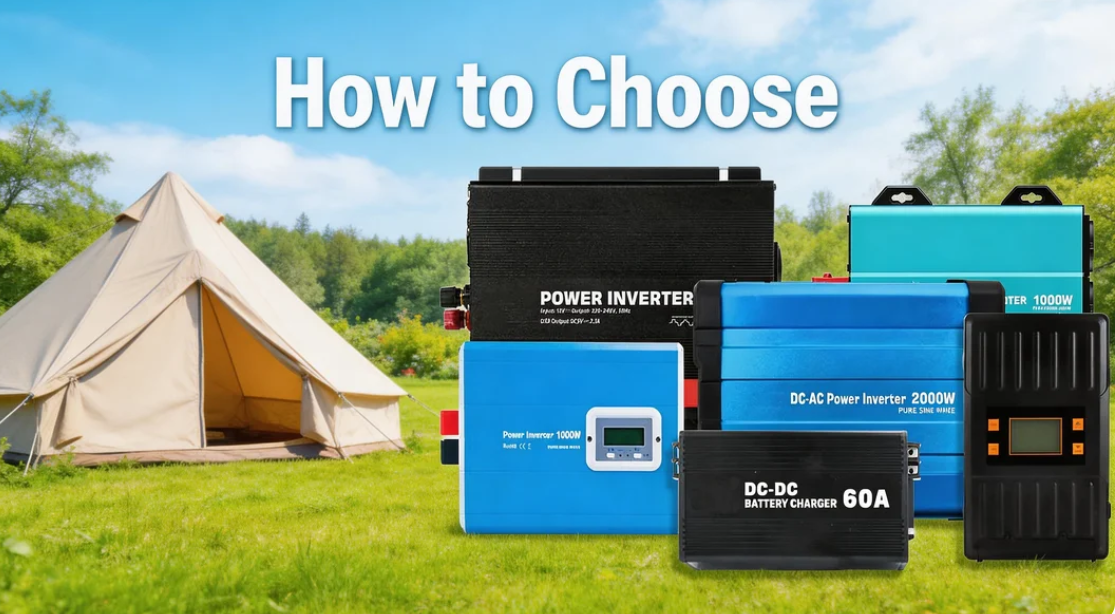
This comprehensive guide answers those questions by comparing waveform types, calculating power requirements, and estimating battery runtime. By the end, you’ll know exactly how to choose the right power inverter for your needs.
I. Waveform Types: Key Differences Between Pure Sine Wave and Modified Sine Wave
The quality of an inverter’s output waveform directly determines which devices it can power and whether they operate safely and reliably.
Pure Sine Wave Inverter
A pure sine wave inverter produces an output waveform virtually identical to utility grid power, with total harmonic distortion (THD) typically below 3%. This makes it ideal for equipment requiring high power quality, such as medical devices, precision instruments, and high‑end audio systems. It can power all types of loads, including:
- Inductive loads – motors, compressors, refrigerators, air conditioners
- Capacitive loads – LED lights, computers, switching power supplies
Pure sine wave inverters operate without noise or efficiency loss. Their conversion efficiency typically exceeds 90%, and the stable output supports long‑term continuous operation – perfect for off‑grid solar systems, home backup power, and RV living.
Modified Sine Wave Inverter
A modified sine wave inverter generates a stepped square wave with THD often exceeding 20%. It is suitable only for simple resistive loads like incandescent bulbs and resistive heaters. When used with motor‑driven equipment (pumps, fans, power tools), a modified sine wave inverter may cause humming, overheating, reduced efficiency, or even permanent damage. Efficiency usually stays below 85%, and output stability is poor.
While modified sine wave inverters cost about one‑third the price of pure sine wave models, their applications are very limited – mainly low‑cost, non‑sensitive uses like basic lighting or heating.
How to Choose?
- Choose pure sine wave if your budget allows and you need to power refrigerators, air conditioners, computers, or any inductive load. It is the only reliable choice for sensitive electronics and provides clean power for off‑grid cabins, emergency home backup, or outdoor work sites.
- Consider modified sine wave only if you use purely resistive loads (e.g., simple bulbs, electric blankets) and are highly cost‑sensitive. Be aware that driving motors with a modified sine wave can lead to overheating, noise, and premature failure.
Pro Tip: For most modern homes, workshops, and mobile applications, the long‑term reliability and device safety of a pure sine wave inverter far outweigh the upfront cost savings of a modified sine wave model.
II. Power Matching: What Power Rating Should You Choose for an Inverter?
Choosing the right inverter power rating is a common mistake. A higher wattage isn’t always better – the key is to match inverter size to your actual load requirements precisely.
Step 1: Calculate Total Load Power
Add up the rated power (in watts) of all appliances you plan to run simultaneously. For example, running a 1000W microwave and a 2000W air conditioner at the same time results in a total load of 3000W. Don’t forget smaller devices – they add up quickly.
Step 2: Add Redundancy for Surge Power
Add 20%–30% extra capacity to handle power fluctuations and inrush current during startup. For motor‑driven equipment (air conditioners, water pumps, power tools), the peak starting current can be 3 to 7 times the rated running wattage. Pay special attention to the inverter’s peak power rating (surge rating) when selecting a model.
Step 3: Match to Your Usage Scenario
| Application | Recommended Inverter Size |
|---|---|
| Residential PV system (home solar) | 5 kW – 15 kW |
| RV / camper van / street vending | 150 W – 3 kW |
| Outdoor work site | 3 kW – 8 kW |
| Energy storage system (ESS) | Peak power × 1.2 margin |
Beware of Inflated Power Ratings
Some low‑cost inverters have misleading specifications. A unit labeled as 5000W may only sustain 3500W continuously and may derate due to overheating after just 30 minutes of full‑load operation. Always focus on rated power (continuous power) rather than peak power, and consult third‑party test data.
III. Runtime Calculation: How Long Will the Battery Last?
Inverter runtime depends on battery capacity × system voltage ÷ load power × conversion efficiency.
Basic Formula
Battery Capacity (Ah) = (Load Power × Desired Runtime) ÷ (Battery Voltage × Depth of Discharge)
- Depth of Discharge (DoD) – 0.8 for lithium, 0.5 for lead‑acid (reserve 20% margin to prevent over‑discharge)
Example: For a 3000W load on a 48V system running 1 hour with lithium batteries:
(3000 × 1) ÷ (48 × 0.8) ≈ 78Ah
Practical Application Examples
| Scenario | Load | Configuration | Runtime |
|---|---|---|---|
| Home emergency backup | 320W (fridge + lights + router) | 24V 150Ah lithium | ~8 hours |
| Outdoor construction site | 800W drill + 1500W cutter (intermittent) | 48V 200Ah LiFePO₄ + 3000W solar | Indefinite with sun |
| RV travel | 1500W AC + 1000W rice cooker | 12V 400Ah gel battery + generator backup | 2–3 hours (AC) |
Battery Type Comparison
Lithium iron phosphate (LiFePO₄) batteries now account for 72% of the energy storage market. Their 1C discharge rate is ideal for inverter demands. Cycle life: up to 3,000 cycles at 80% DoD, far exceeding lead‑acid’s 500 cycles at 50% DoD. While initial cost is higher, long‑term value is much better.
Key Insight: For daily or frequent off‑grid use, LiFePO₄ is the best investment. For very occasional backup (a few times per year), lead‑acid may still be acceptable.
IV. Voltage System Selection: 12V, 24V, or 48V?
The choice of system voltage directly affects efficiency and safety. Higher load power requires higher voltage.
| Total Load | Recommended Voltage | Typical Battery Capacity |
|---|---|---|
| < 2000W | 12V | ~200Ah |
| 2000W – 5000W | 24V | ~400Ah |
| > 5000W | 48V | >600Ah |
Example for a 3000W inverter:
- 48V system → 150–200Ah battery (about 5 hours runtime)
- 24V system → 300–400Ah
- 12V system → not recommended (excessive current leads to overheating)
Why higher voltage is better: Higher voltage means lower current, which reduces line losses, minimizes heat, and improves overall efficiency. For systems above 3000W, 48V is the most efficient choice.
V. Industry Trends and Buying Tips
2025 Market Highlights
Mainstream inverters have seen significant improvements in efficiency and intelligence. MPPT tracking accuracy now exceeds 99.5%, and peak efficiency reaches over 98%. Hybrid inverters are a hot market segment – the global smart hybrid inverter market was valued at approximately $5.163 billion in 2025. These products not only convert solar energy to AC power but also store excess energy in batteries for self‑use, enabling “solar + storage” integration.
Key Features to Check When Buying
- Safety protections – Ensure the inverter includes over‑voltage, under‑voltage, short‑circuit, and over‑temperature protection. Missing these can increase failure rates by up to 300%.
- Cooling design – Metal enclosures dissipate heat 40% better than plastic. For high‑power models, active fan cooling is recommended.
- Certifications – For grid‑tied models, look for CQC/CEI‑021 certification; for export, TÜV/UL1741 certification is required.
- Battery compatibility – BMS communication protocols vary among lithium battery manufacturers. Confirm that the inverter supports your battery’s CAN or RS485 protocol before purchasing.
Smart Buying Strategy
Avoid the “bigger is better” trap – an oversized inverter increases standby power consumption. The most reasonable choice is 1.2 to 1.5 times your total load power. Also consider over‑provisioning battery capacity by 20–30%, which extends battery life and provides a buffer for extreme weather or unexpected usage.
Conclusion
Selecting the right inverter is about finding the best balance between power demand, device compatibility, budget, and usage environment. First, clearly define what devices you need to run, how long you need to run them, and under what conditions. Then, apply the waveform selection, power calculation, and runtime formulas from this guide. By doing so, you can confidently choose a pure sine wave inverter that delivers reliable, efficient off‑grid power – whether for your home, RV, or remote work site.
Post time: Mar-31-2026