
Introduction: The Pain Point That Started a Revolution
Every seasoned RVer knows the feeling. You’re parked in a remote spot, the sun is setting, and you decide to run the microwave while the coffee maker is still going. Suddenly, the lights dim, the inverter starts beeping, and your entire electrical system groans under the strain. It’s not a user error — it’s a fundamental limitation of 12V power systems.
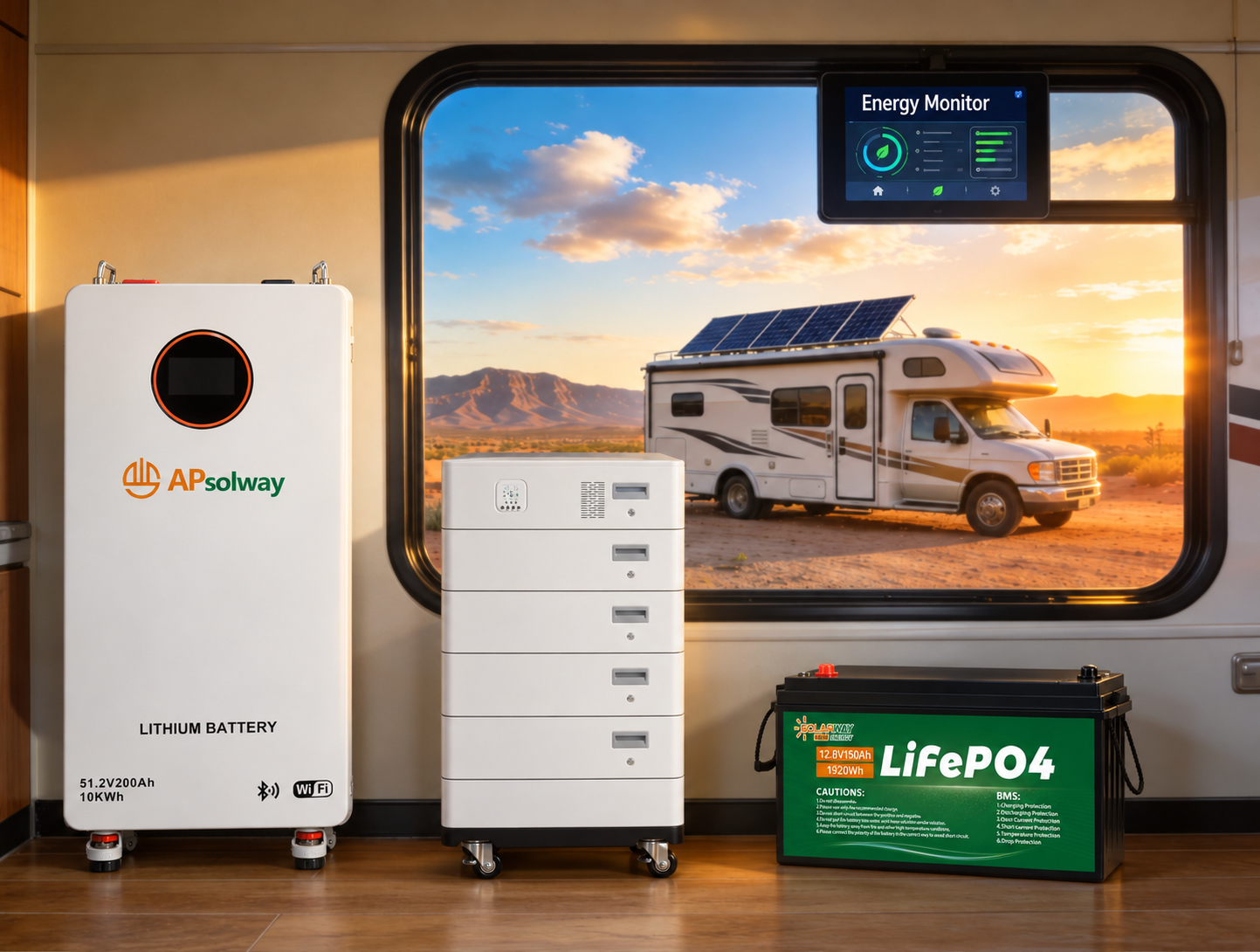
For decades, 12V has been the default standard for RV electrical systems. It worked well enough when RVs were simple: a few lights, a water pump, maybe a small TV. But modern RVers demand more. They want to run air conditioners, induction cooktops, laptops, Starlink dishes, and coffee makers — often all at once. And 12V simply wasn’t designed for that kind of load.
That’s why the RV industry is undergoing a major structural shift toward 48V electrical systems. This isn’t a niche trend or a passing fad. It’s a fundamental rethinking of how mobile power is designed, distributed, and consumed. And companies like Solarway are leading the charge with hybrid inverters and LFP battery storage systems built for this new era of high-voltage efficiency.
Why 48V Is Replacing 12V: The Engineering Case
The case for 48V isn’t marketing hype. It’s basic electrical engineering.
75% less current means thinner cables, less heat, and less voltage drop. If you need to deliver 3,000 watts of power, a 12V system requires 250 amps of current. A 48V system requires only about 62.5 amps — roughly 75% less. Lower current means thinner, lighter cables, less heat generation, and significantly less voltage drop across long wire runs. On 12V, voltage drop over 20–40 feet can be significant, forcing you to oversize cables. On 48V, voltage drop becomes negligible.
4x the power density — more energy in less space. A 48V battery bank stores the same amount of energy in roughly a quarter of the size compared to a 12V bank. A 12V system with 9.6kWh of usable energy requires a massive, heavy battery bank — often four or more large lithium batteries wired in parallel. A 48V system with the same capacity can be achieved with a single, compact 20Ah 48V battery. That’s a fraction of the footprint, weight, and wiring complexity.
Higher inverter efficiency — 95%+ at 48V. At 12V, inverters often struggle under heavy loads, with efficiency dropping significantly as demand increases. At 48V, premium inverters consistently achieve 95%+ efficiency, even under demanding loads. This means less energy wasted as heat, longer battery life, and more reliable performance when you need it most.
Real-World Impact: What 48V Means for Boondockers
Imagine you’re a boondocker running an air conditioner for four hours a day. On a 12V system, you’d need a massive battery bank (often 800Ah+ of lithium), a huge solar array (1,200W+), thick heavy cabling, and a high-capacity inverter that may still struggle under load.
On 48V, the same scenario looks very different: a 20Ah 48V bank (9.6kWh) handles AC, laptops, cooking, and more. A moderate solar array recharges the system quickly. Thinner cables simplify installation. And a high-efficiency inverter runs cool and quiet.
The difference isn’t incremental. It’s a completely different experience. 48V isn’t about surviving off-grid — it’s about thriving off-grid.
Solarway: Built for the 48V Era
At Solarway, we’re not just watching this shift — we’re building for it. Our hybrid inverters and LFP battery storage systems are designed from the ground up to deliver high-voltage efficiency, whether you’re powering an RV adventure or building home energy resilience.
Our product ecosystem includes hybrid inverters optimized for 48V systems, LFP battery storage with high power density and long cycle life, solar charge controllers designed for high-voltage arrays, and complete off-grid solutions for RVs, boats, sheds, and homes.
We believe the future of mobile and off-grid energy is high-voltage, high-efficiency, and highly integrated. Explore our solutions at https://www.solarwaytech.com/.
Frequently Asked Questions About 48V RV Systems
Q: Can I upgrade my existing 12V RV to 48V?
A: Yes, but it’s not a simple swap. You’ll need a 48V battery bank, a 48V inverter, and possibly new wiring and charge controllers. It’s best to work with a company like Solarway that offers complete system solutions.
Q: Is 48V safe?
A: Yes. 48V is considered low voltage and is safe for consumer use. It’s actually safer than 12V in some ways because lower current means less heat and lower risk of fire.
Q: What about appliances that run on 12V?
A: You can use a 48V-to-12V DC-DC converter to power 12V appliances. Many 48V systems include these converters as standard.
Conclusion: The Future Is 48V
The 48V RV power revolution is not a passing trend. It’s a fundamental shift driven by real-world needs: more power, less space, higher efficiency, and greater reliability. Whether you’re a full-time RVer, a weekend boondocker, or someone building a home energy storage system, 48V offers a clear path forward.
At Solarway, we’re proud to be part of this shift. Our hybrid inverters and LFP battery storage systems are designed to deliver the performance, efficiency, and reliability that modern off-grid living demands.
The 48V upgrade isn’t about surviving off-grid — it’s about thriving off-grid.
Have you made the switch from 12V to 48V in your setup? Drop a comment below and share your experience.
About Solarway
Solarway is a provider of advanced solar and energy storage solutions, specializing in hybrid inverters, LFP batteries, and complete off-grid systems for RVs, boats, homes, and more. Learn more at Battery Factory – China Battery Manufacturers and Suppliers (solarwaytech.com)
Post time: Sep-15-2026