
The energy storage market is facing a growing question: can demand keep pace with battery manufacturing expansion?
At the 2026 World Power Battery Conference, Envision Senior Vice President Tian Qingjun warned that rapid investment in energy storage cells could create significant oversupply pressure. For solar battery distributors, installers and OEM buyers, the implications extend beyond LFP battery prices to supplier reliability and long-term system performance
Energy Storage Expansion Raises Oversupply Concerns
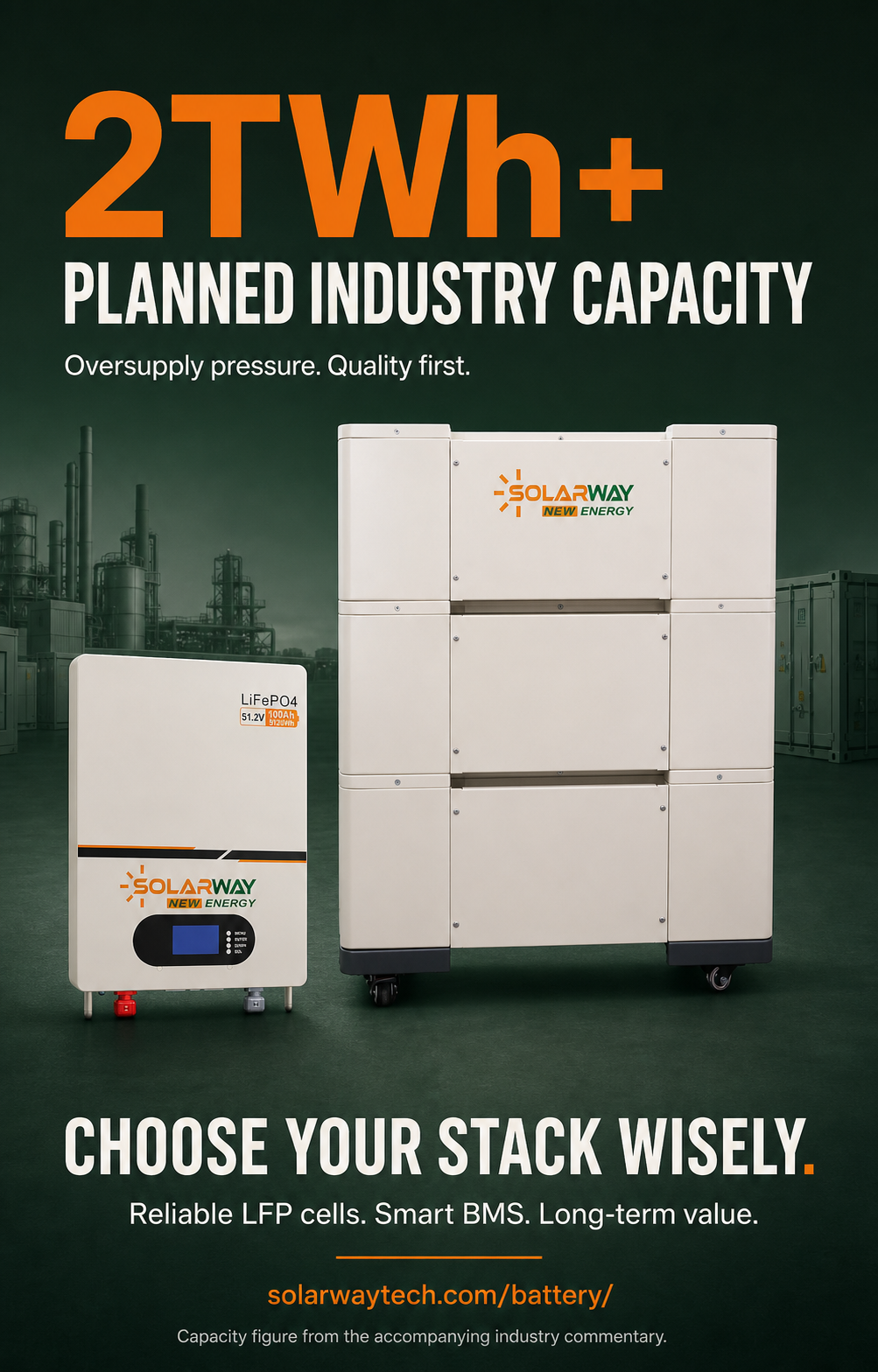
According to conference coverage published on September 4, Tian outlined more than 800GWh of planned storage-cell capacity expansion, with completed capacity expected to reach approximately 1.2–1.5TWh by the end of 2026 and total planned capacity exceeding 2TWh. He warned that expansion could outpace actual global market demand. Read the conference report.
These figures describe manufacturing capacity and expansion plans. They do not represent batteries already produced, delivered or installed.
The warning raises concerns familiar from the solar industry: intense price competition can put pressure on supplier margins and create incentives to reduce costs in ways that compromise quality.
Could Battery Oversupply Lower Home Energy Storage Costs?
If additional manufacturing capacity enters production faster than orders grow, it could put downward pressure on storage-cell prices. For buyers planning a home energy storage system or an off-grid solar power system, this may create more competitive sourcing opportunities.
However, lower cell prices do not translate directly into equivalent reductions in installed system costs. A complete battery energy storage system also depends on the battery management system, inverter, enclosure, installation and after-sales support.
Buyers should therefore compare complete system quotations and operating requirements, alongside the price per kilowatt-hour.
What to Check When Sourcing a LiFePO4 Solar Battery
A competitive quotation is a starting point. Product selection should also account for:
- Usable energy: Compare usable capacity under the specified operating conditions.
- Cycle-life conditions: Check depth of discharge, temperature and end-of-life criteria behind cycle claims.
- Smart BMS protection: Confirm protection functions and supported communication protocols.
- Inverter compatibility: Verify the exact battery and inverter combination before ordering.
- Supplier support: Review warranty terms, technical documentation and replacement arrangements.
For installers and OEM partners, these checks help assess whether a lower initial purchase price will deliver value throughout the system’s service life.
Solarway Batteries for Residential Solar Storage
Solarway’s battery portfolio includes stackable LiFePO4 batteries and wall-mounted lithium batteries for home solar storage and off-grid applications.
The Solarway 51.2V 100Ah stackable LiFePO4 battery features an integrated 100A BMS and LCD display. Its published specifications list 6,000 cycles at 80% depth of discharge and support for up to 15 batteries in parallel.
For projects with different space requirements, the Solarway solar battery range also includes wall-mounted 51.2V 100Ah and 200Ah LiFePO4 options with built-in displays and BMS protection.
Selecting between a wall-mounted battery and a stackable solar battery should reflect available installation space, required usable energy and future expansion plans.
Matching Battery Storage with a Hybrid Solar Inverter
Battery selection is only one part of a residential energy storage project. The inverter must support the battery’s voltage range, charge and discharge limits, communication requirements and intended operating mode.
Solarway’s solar power product portfolio includes hybrid and off-grid solar inverters with integrated MPPT charging, including the IPS6500 6.5kW model with a 120A MPPT solar charger. Buyers should confirm the selected model’s functions and battery compatibility for their project.
A coordinated battery and inverter configuration helps installers develop a system suited to household consumption, solar generation and backup-power requirements.
Choose Long-Term Value in a Competitive Battery Market
Potential oversupply gives buyers a reason to review sourcing options carefully. It also makes product quality, supplier support and system compatibility central to purchasing decisions.
For distributors, installers and OEMs, the practical opportunity is to secure competitive terms while maintaining clear technical requirements.Battery Factory – China Battery Manufacturers and Suppliers (solarwaytech.com)
Planning a residential solar storage or off-grid power project? Explore Solarway LiFePO4 batteries and contact Solarway to discuss battery capacity, inverter matching and project requirements.
Post time: Sep-08-2026