
Why do car inverters overheat and shut down? Is it normal protection or a sign of poor quality? Learn the truth about thermal issues, safety risks, and how Solarway’s 100% ATE testing ensures real reliability.
Car Inverter Overheating Shutdowns – The #1 Summer Headache for Vehicle Owners
On a hot summer day, the inside of a parked car can easily exceed 50°C (122°F). Many drivers find that their car inverter runs for just ten minutes before suddenly cutting off. The words “high-temperature protection” flash on the screen. The casing is too hot to touch, and sometimes there’s even a burning smell.
Why do car inverters overheat and shut down? Is this a legitimate safety mechanism, or does it reveal poor design? A 2026 industry survey found that 58% of consumers consider cheap car inverters a major safety hazard, and overheating/tripping is one of the most common complaints. This article dives deep into the root causes of heat-related inverter failures and shows how brands like Solarway solve this pain point with ATE full inspection and extreme testing.
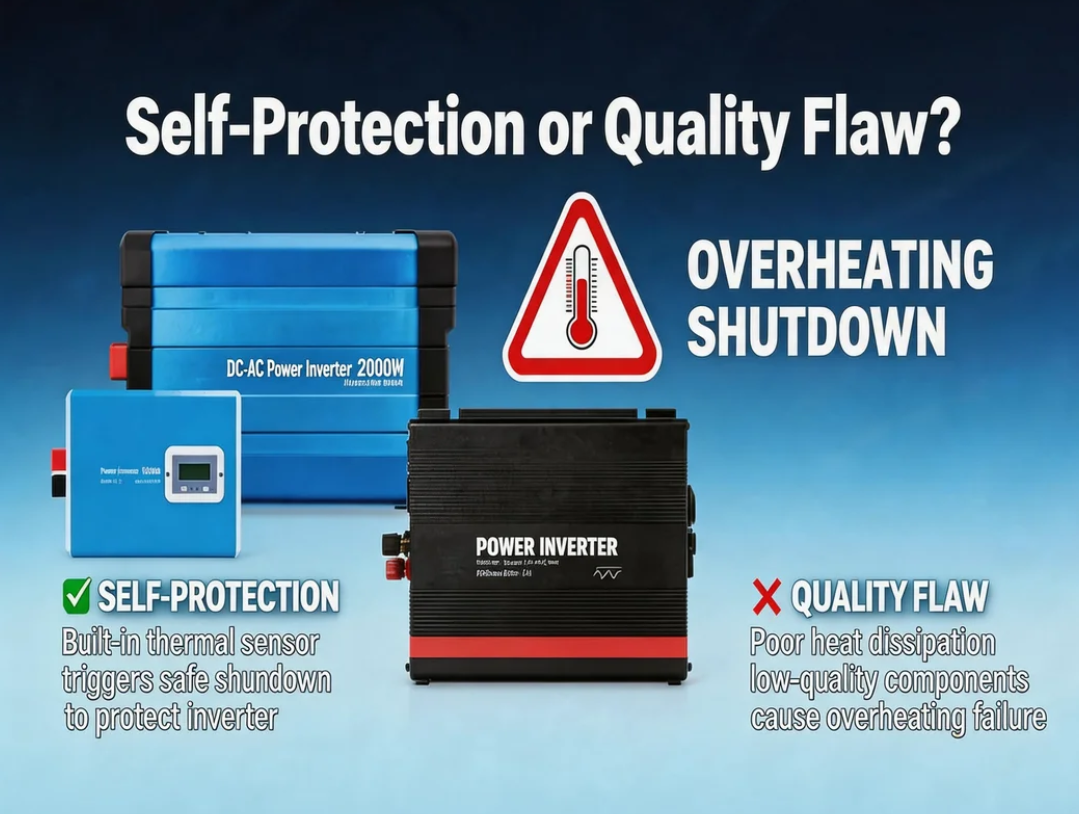
1. The Logic Behind Overheating Shutdowns – Self-Protection or Design Flaw?
To understand overheating shutdowns, you first need to know the over-temperature protection mechanism.
Quality car inverters come with proper protection circuits. They monitor internal temperature in real time – when the temperature of power devices (like MOSFETs or IGBTs) exceeds a preset safe threshold, the control system cuts output to prevent heat buildup that could lead to short circuits or fires. This is a legitimate safety feature, much like a circuit breaker in your home.
But the real question is: when the inverter shuts down, has it truly reached its limit, or was it never built to meet its claimed specs in the first place?
Frequent overheating shutdowns often expose a trust gap – some products trigger thermal protection far below their labeled continuous power because they lack design margin. This reflects a fundamental lack of real-world reliability.
2. Why Cheap Inverters “Run a Fever” – Three Technical Flaws
If an inverter repeatedly overheats and shuts down, the problem usually lies in one of three areas:
Flaw 1 – Undersized, Low-Grade Components
Heat dissipation and power tolerance are critical for stable inverter operation. Cheap inverters cut costs by using recycled or substandard power chips (MOSFETs/IGBTs). More importantly, they use 85°C consumer-grade electrolytic capacitors instead of 125°C automotive-grade solid capacitors. On a hot summer day, cabin temperatures above 60°C already push 85°C capacitors to their limit. Prolonged operation near the limit causes rapid aging, capacity loss, and eventually bulging or leaking. Tests show that a cheap inverter labeled 3000W may deliver less than 1800W continuous.
Flaw 2 – Poor Thermal Design
Cooling is the lifeline of an inverter, but many cheap models barely have a cooling system. Poor thermal design means heat accumulates, accelerating component aging and degradation. Some low-end products even omit cooling fans altogether, using thin aluminum heatsinks (or none). In summer, temperatures rise rapidly and trigger over-temperature protection within minutes.
Flaw 3 – Inadequate Protection Circuits
Under overload conditions, excessive current can permanently damage MOSFETs or IGBTs. Quality inverters monitor current, voltage, and temperature, cutting power immediately when something goes wrong. But cheap inverters often have fake protection – either the thresholds are set too high (so protection never kicks in), or the response is too slow. By the time it trips, internal damage has already occurred. Many also use non-flame-retardant casings, which can catch fire if overheated.
3. The Real Cost of Thermal Runaway – From Poor User Experience to Broken Brand Trust
Overheating shutdowns aren’t just an inconvenience. They cause cascading damage to both users and brands.
When users repeatedly experience overheating shutdowns, they don’t think “this inverter has good protection.” They think “this product is junk.”
2026 industry data confirms this. 38% of consumers switch brands due to poor performance or failures – loyalty is collapsing. Online sales still show 57% are low-end white-label products, which often fail badly in heat tests, directly causing customer churn. Cheap modified sine wave inverters can also inject high-frequency harmonics back into the vehicle’s 12V/24V network, potentially damaging sensitive electronics like ABS computers or transmission TCUs. The overheating shutdown might save the inverter, but your car’s computers may already be compromised.
In January 2026, Toyota recalled about 55,000 Camry and Corolla Cross hybrid vehicles globally because a loose bolt in the inverter unit posed short-circuit and fire risks. This shows that thermal safety in inverters has become a serious industry-wide concern – from OEMs to aftermarket parts.
4. Stricter Regulations Are Reshaping the Industry – 2026 Certification Era
The surge in overheating and safety issues is pushing regulators worldwide to tighten inverter certification requirements.
In March 2026, a major testing lab reported that smart inverter grid-connection standards are becoming stricter – for example, CSIP-AUS v1.2 becomes mandatory in parts of Australia from July 2026. In China, from August 1, 2026, electric vehicle power supply equipment cannot be manufactured, sold, or imported without CCC certification, which includes rigorous tests for shock protection, short-circuit protection, fire resistance, and flame retardancy.
Higher certification barriers will gradually push out manufacturers that cut corners on components, thermal design, and protection circuits. A safer, more reliable, and more regulated industry ecosystem is taking shape.
5. Solarway: Solving Overheating Shutdowns at the Source – ATE Full Inspection & Extreme Testing
To solve the industry-wide pain point of frequent overheating shutdowns, quality control at the source is essential. To tackle thermal management challenges in vehicle inverters, Solarway applies a “prevention first” philosophy throughout manufacturing.
On Solarway’s production line, “spot checks” are a thing of the past – replaced by 100% ATE (Automated Test Equipment) full inspection. The ATE system uses PC and PLC control to fully automate the testing process: power-on, execution, shutdown, and data upload. This ensures consistency that manual spot checks can never achieve.
Among the rigorous tests covered by ATE, the most directly related to overheating shutdowns are:
High-Temperature Aging Test – Inverters run continuously for 48+ hours in a 45°C–60°C (113°F–140°F) chamber, simulating extreme summer cabin conditions and exposing early-life component failures.
Over-Temperature Protection Functional Test – The system injects simulated signals into the temperature sensing circuit to verify that the inverter correctly reduces power or shuts down at the preset thermal threshold.
Vibration & Impact Test – Simulates continuous bumps on unpaved roads and sudden braking inertia, verifying the reliability of PCB solder joints and wiring terminals under mechanical stress.
Full-Load Continuous Output Test – Monitors the real-time temperature rise curve of power devices (MOSFETs/IGBTs) under rated load, ensuring they stay below the thermal limit at labeled power.
Every Solarway inverter leaves the factory with a complete test report – a systematic response to the overheating shutdown problem and a hard commitment to user safety.
6. Buyer’s Guide: How to Avoid Overheating Shutdowns from the Start
You don’t need to be an engineer to avoid overheating shutdowns. Follow these three simple rules:
1. Waveform – Always choose pure sine wave.
Pure sine wave inverters have total harmonic distortion below 3%. Not only is the power cleaner, but they also typically use better components and more robust protection circuits.
2. Cooling & Build – Full metal housing + independent cooling fan.
Metal housings dissipate heat far better than plastic. Ball-bearing fans last longer and are quieter than cheap sleeve-bearing fans.
3. Certifications & Warranty – CE, TÜV, UL, CCC, etc. are a must.
A brand that offers a “replace-not-repair” policy and a 3+ year warranty shows real confidence in its product reliability.
Usage tip: For loads above 120W, connect directly to the battery instead of using the cigarette lighter socket. On hot days, keep the inverter ventilated – don’t cover or block the cooling vents.
Conclusion – Overheating Shutdowns Are Not an Inverter’s Destiny
Overheating shutdowns in car inverters are ultimately a battle between “low-price competition” and “quality commitment.” Cheap inverters turn overheating into a daily annoyance. But brands like Solarway – with 100% ATE full inspection and extreme testing – prove that a well-designed, properly built inverter should deliver stable output even in high heat, and provide accurate protection only when truly needed.
The 2026 inverter market is undergoing a deep transformation from “cheap and unreliable” to “quality first.” For consumers, spending a little more on a rigorously tested brand means real power freedom and peace of mind during summer travels.
Post time: May-19-2026