
Shanghai Customs data shows China’s “New Three” exports — electric vehicles, lithium batteries, and solar PV products — surged 70.2% YoY in July 2026. Learn what this means for the global energy storage and power electronics market. 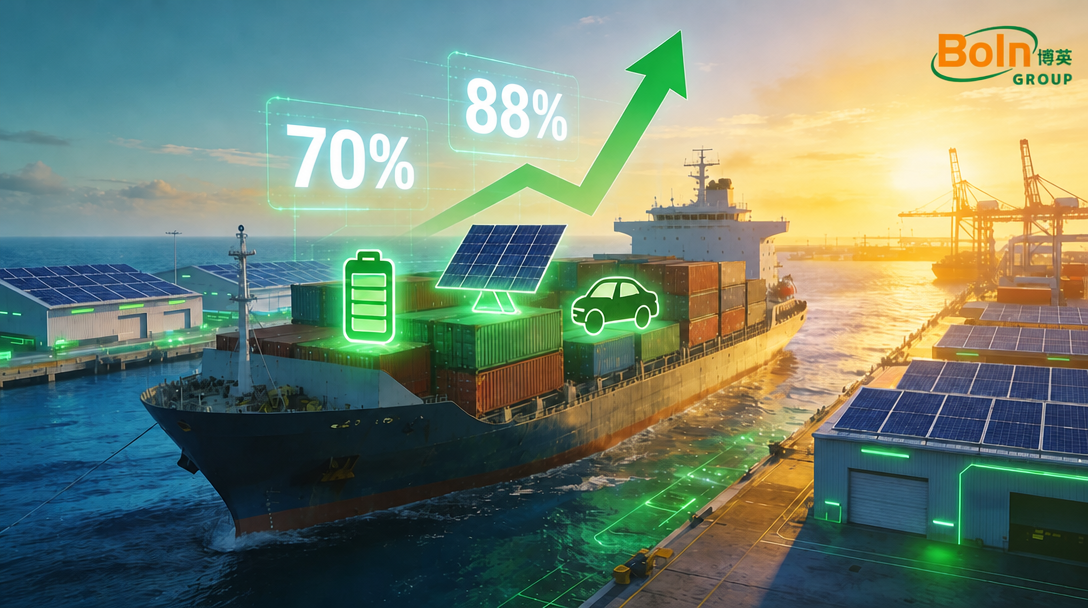
China’s green energy exports just posted one of their strongest months on record.
Shanghai Customs released trade data for July 2026, and the results are remarkable. The so-called “New Three” products — electric vehicles (EVs), lithium-ion batteries, and solar photovoltaic (PV) products — recorded a combined export growth of 70.2% year-over-year, reaching 271.7 billion yuan in a single month.
Breaking it down further:
Electric vehicle exports: +88.7% YoY
Lithium battery exports: +20.8% YoY
Solar PV product exports: +79.2% YoY
Ship exports (including car carriers): +321.8% YoY
This isn’t a one-time anomaly. Shanghai’s total trade has grown for 18 consecutive months. In the first seven months of 2026, the city alone recorded 3 trillion yuan in total imports and exports — a 17.7% increase compared to the same period last year.
And this is just Shanghai. Nationwide, China’s goods trade reached 30.13 trillion yuan in the first seven months, up 17.3% year-over-year, with green and low-carbon products such as EVs and lithium batteries posting double-digit growth for the 17th consecutive month.
Why This Matters for the Global Energy Storage Industry
These numbers tell a bigger story: the world is electrifying at a pace that few predicted even two years ago. And behind every electric vehicle, every solar installation, and every battery storage system, there is a critical piece of infrastructure that makes it all work — power conversion and energy management systems.
More EVs Mean More Demand for Car Inverters and Onboard Power
With EV exports surging 88.7%, the demand for vehicle power electronics is scaling at the same pace. Every electric vehicle requires sophisticated power conversion systems — from traction inverters that drive the motor, to auxiliary car inverters that power onboard equipment, RV setups, and mobile charging stations.
The global traction inverter market alone is projected to grow from $26.5 billion in 2026 to $150.9 billion by 2036, driven by silicon carbide (SiC) technology and the industry-wide shift to 800V architectures. As automakers race to higher-voltage platforms, inverters must deliver better efficiency, less heat, and smaller form factors — creating significant opportunities for power electronics manufacturers who can meet these demands.
For companies like Solarway, which specializes in car inverters and vehicle power solutions, this export boom signals a rapidly expanding addressable market across regions including Southeast Asia, Latin America, Africa, and the Middle East.
More Solar Installations Abroad Mean More Need for Hybrid Inverters and Battery Storage
The 79.2% surge in solar PV exports reflects a clear trend: countries around the world are accelerating their renewable energy deployments. But solar panels alone don’t complete the system. Every rooftop installation, every commercial solar project, and every utility-scale solar farm needs:
Hybrid inverters to manage the flow of energy between solar panels, batteries, and the grid
Energy storage batteries to store excess power for nighttime use or grid backup
Intelligent energy management systems to optimize self-consumption and time-of-use savings
The global residential energy storage market is booming precisely because homeowners want energy independence — protection from grid outages, lower electricity bills through peak-shaving, and the ability to go off-grid when needed. Products like the Solarway home hybrid inverter system and 51.2V 200Ah lithium battery are designed to address exactly these needs, offering modular expandability, smart monitoring, and reliable performance in diverse climates.
More Global Trade Means More Opportunities for Energy Storage Companies
The 17 consecutive months of trade growth isn’t just about volume — it’s about market diversification. Shanghai’s trade data shows particularly strong growth with ASEAN (+54.3%), with Vietnam (+109.9%) and Singapore (+79.4%) leading the way. Trade with the EU also grew 7.7%. https://www.solarwaytech.com/solar-hybrid-inverter/
For energy storage and power electronics companies, this means:
Southeast Asia is emerging as a high-growth market for solar+storage solutions
Latin America continues to invest in off-grid and hybrid power systems
Africa remains one of the most promising markets for residential solar and battery storage
The Middle East is rapidly deploying utility-scale solar with battery storage integration
Companies with reliable product lines — spanning car inverters, hybrid inverters, and energy storage batteries — are positioned to capture demand across multiple geographies simultaneously.
The Infrastructure Behind the Boom
While headlines focus on the finished products — the EVs, the solar panels, the battery packs — the real growth story lies in the infrastructure that makes these products function reliably. https://www.solarwaytech.com/solar-panel-products/
Consider this: every solar+storage system requires a hybrid inverter to manage bidirectional power flow. Every EV charging station needs power conversion equipment. Every off-grid installation depends on pure sine wave inverters to run sensitive electronics safely. Every energy storage deployment relies on battery management systems (BMS) to ensure safety, longevity, and performance.
This is where companies like Solarway play a critical role. With a product portfolio covering off-grid inverters, car inverters, hybrid inverters for residential energy storage, lithium batteries, and portable power stations, Solarway provides the essential building blocks that enable the global energy transition to actually work at scale.
The July 2026 data is a strong signal, but several trends will shape the next phase of growth:
SiC (Silicon Carbide) adoption in power electronics is accelerating, enabling more efficient inverters with smaller footprints — critical for both EV and residential applications.
Solid-state battery commercialization is moving closer to reality, with Japanese manufacturers leading pilot production. This could reshape the energy storage supply chain within 3-5 years.
Modular energy storage systems are becoming the industry standard, allowing homeowners to start with a single battery module and expand capacity as their needs grow — eliminating the need to oversize initial installations.
Grid-scale storage is entering a new phase, as countries recognize that renewable energy targets cannot be met without massive battery storage deployment alongside solar and wind.
Electric truck and commercial vehicle electrification is accelerating, creating additional demand for robust power conversion systems, from traction inverters to auxiliary car inverters for onboard equipment.
Conclusion: The Power Electronics Opportunity Is Just Beginning
China’s “New Three” export surge isn’t just a trade statistic — it’s a window into the global energy transformation that’s already underway. Every EV exported carries power electronics. Every solar panel shipped abroad needs an inverter. Every battery system deployed requires intelligent energy management. https://www.solarwaytech.com/battery/
For manufacturers, distributors, and solution providers in the energy storage and power conversion space, the message is clear: the market is growing faster than expected, the technology is maturing rapidly, and the companies positioned with reliable, diverse product lines will capture the most value.
The world is electrifying. The question is no longer if — but how fast, and who will power it.
About Solarway: Solarway (solarwaytech.com) is a manufacturer specializing in off-grid inverters, car inverters, hybrid inverters for home energy storage, lithium batteries, and portable power stations.
Contact: info@solarway.cc | solarwaytech.com
Post time: Aug-19-2026