
As electric vehicle range remains the foremost concern for consumers, the automotive inverter—once a behind-the-scenes component—has moved firmly into the technological spotlight. According to industry data, the global automotive on-board power inverter market was valued at approximately $525–665 million in 2025 and is projected to grow at a compound annual growth rate (CAGR) of 9–10%, reaching nearly $1 billion by 2032. Within this rapidly expanding market, silicon carbide (SiC) has emerged as the undisputed technology leader, commanding over 55% of the market share.
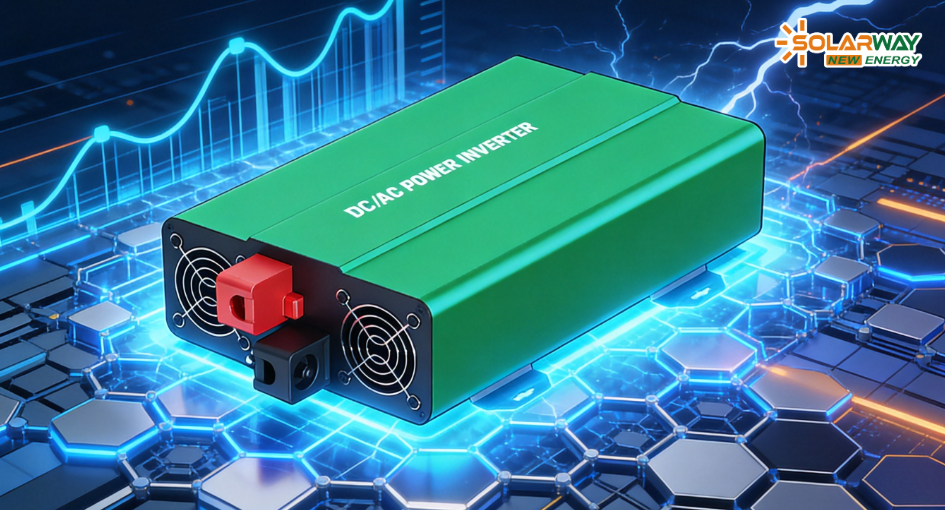
The SiC Efficiency Revolution
In the electric vehicle sector, every marginal gain in driving range matters enormously. SiC power devices can improve electric drivetrain efficiency by nearly 10 percentage points compared to traditional silicon-based counterparts. This is not an incremental improvement—it is a fundamental efficiency breakthrough.
SiC materials exhibit superior physical characteristics: they can operate stably at temperatures exceeding 200°C, enabling simpler thermal management systems, more compact device footprints, and reduced cooling energy consumption. According to TrendForce, global SiC inverter installations surpassed 1.5 million units in Q3 2025 alone, with penetration among new energy vehicles reaching 22%. The SiC inverter penetration rate in China’s 800V platform vehicles has reached an impressive 76%.
The 800V Platform Gold Rush
The proliferation of 800V high-voltage platform architectures represents the true growth catalyst for SiC technology. 800V platforms impose more demanding requirements on power devices—higher voltage tolerance, lower switching losses, and superior thermal performance—all of which play directly to SiC’s strengths. The global market for 800V silicon carbide inverters was estimated at $184 million in 2024 and is forecast to reach $923 million by 2031, representing a CAGR of 22.3%. As 800V platforms scale from mid-to-high-end segments toward mainstream adoption, SiC’s dominance in this space is expected to strengthen further.
Asia-Pacific Dominance and the Rise of China’s SiC Supply Chain
Asia-Pacific has emerged as the undisputed center of gravity for the global automotive inverter market, contributing 38–45% of the global wide-bandgap power device market share. Within this ecosystem, China’s rise has been particularly remarkable.
The International Energy Agency (IEA) reported that global EV sales exceeded 17 million units in 2024, with China accounting for approximately half of that total. As the new energy vehicle industry flourishes, China’s SiC supply chain is undergoing a critical transformation—from follower to frontrunner.
In June 2025, U.S. SiC giant Wolfspeed filed for Chapter 11 bankruptcy protection, signaling a profound restructuring of the global SiC industry landscape. Chinese SiC substrate manufacturers SICC and TanKeBlue have rapidly emerged as major global players, together capturing approximately 40% of the global SiC substrate market—a dramatic shift from just 10% three years ago. TanKeBlue and SICC now hold individual market shares of 17.3% and 17.1% respectively, ranking second and third globally. East Asia now accounts for 45–55% of global SiC power transistor consumption, with 1200V devices representing 50–55% of that total.
The GaN Challenge
SiC’s throne is not unassailable. Gallium nitride (GaN), another wide-bandgap semiconductor, is emerging as a challenger with distinct advantages. GaN offers higher switching efficiency in high-frequency applications and cost advantages at voltage levels below 650V. For applications such as on-board chargers (OBC) and DC-DC converters, GaN is steadily gaining market share.
Industry analysis suggests that SiC and GaN are not simply substitutes but present a complementary landscape: SiC dominates high-voltage (1200V and above), high-power applications, while GaN excels in medium-voltage, high-frequency applications. Together, they form the twin pillars of the wide-bandgap semiconductor era.
The AI-Driven Intelligent Transformation
Artificial intelligence is profoundly reshaping inverter design and control. AI algorithms can optimize switching strategies in real time, predict device aging, enhance energy conversion efficiency, and provide more precise power allocation for EV battery management systems. The intelligent inverter is no longer merely a power conversion unit—it is becoming the “smart brain” of EV energy management.
Beyond Passenger Vehicles: The Broader Inverter Landscape
Passenger vehicles currently dominate the automotive inverter market, accounting for approximately 71% of total share. However, the value of inverters extends far beyond passenger cars. In the RV and camping market, inverters are becoming the energy core of “homes on wheels.” In residential energy storage, inverters serve as the critical bridge between solar panels and household grids. In off-grid applications—whether remote communication base stations or emergency backup power—inverters play an indispensable role.
Strategic Implications for Solarway New Energy
For companies like Solarway New Energy—a national-level “Specialized, Refined, Unique, and Innovative” (SRUI) “Little Giant” enterprise specializing in the R&D, production, and sales of integrated vehicle-mounted photovoltaic-storage-charging off-grid power systems—this industry transformation presents both unprecedented opportunities and strategic challenges.
Solarway New Energy has established itself as a leading designer and manufacturer of robust off-grid power inverters and tailored energy systems, exporting approximately 50,000 to 100,000 power inverters annually. With a Sino-German joint venture heritage and active engagement in the German market for over a decade, the company holds certifications including ISO 9001, ISO 14001, CE, ROHS, E-MARK, ETL, TÜV, FCC, and SGS.
The gradual decline in SiC material costs and the proliferation of 800V platforms will unlock greater performance improvements and cost-reduction potential for inverter products. The maturation of China’s SiC supply chain will lower the procurement threshold for core devices. Simultaneously, AI integration presents a critical differentiator: incorporating AI algorithms into inverter products could become a key competitive advantage. And as GaN and other emerging technologies challenge the status quo, manufacturers must maintain strategic clarity in their technology roadmaps.
Conclusion
From a market valued at hundreds of millions to a projected multibillion-dollar industry, the global automotive inverter market stands at the threshold of a new growth cycle. With SiC technology commanding a 55% share, it has proven itself the technology darling of this era, while the rise of China’s supply chain has injected new variables into the global industry landscape. Driven by the triple forces of electrification, intelligence, and clean energy, the automotive inverter—once a behind-the-scenes player—is entering its moment in the spotlight. For every participant in this ecosystem, including Solarway New Energy, this is both a technological crucible and a gift of the era.
Post time: Jun-18-2026