
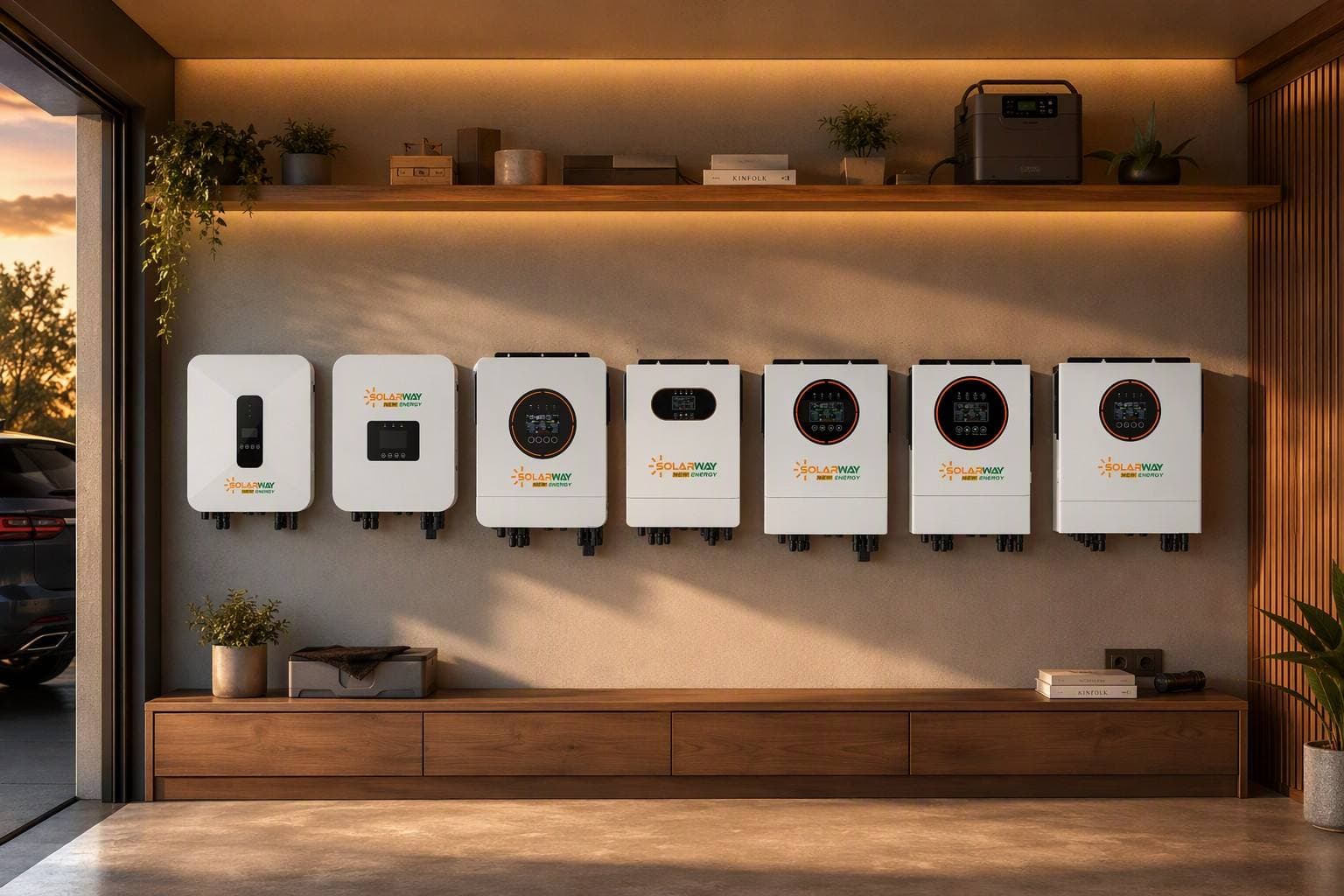
With the growing popularity of residential PV energy storage systems, hybrid inverters – as the “brain and heart” of the system – are finding their way into more and more homes and commercial settings. Yet when faced with a wide array of models on the market, users consistently ask two questions: “Is installation really that complicated?” and “Is it safe to install outdoors?”
This article breaks down the key considerations for selecting a hybrid inverter from two main perspectives: ease of installation and outdoor protection capability.
1. Installation Complexity: From “Specialist Job” to “Standardized Process”
In the early days, inverter installation indeed required professional electrical engineers to spend half a day or even longer on wiring, configuration, and commissioning. Today, however, mainstream hybrid inverters have significantly streamlined the installation process.
Taking the hybrid inverter series from Solarway (under Boin Group) as an example, their products generally feature standardized terminal blocks + modular design. Users can complete the basic installation by following the manual through these steps: https://www.solarwaytech.com/solar-hybrid-inverter/
PV input wiring – connect the solar panel array (DC side).
Battery wiring – connect the energy storage battery (supports lead-acid/lithium batteries; some models include lithium battery activation).
AC output wiring – connect to household loads or grid feed-in terminals.
Communication and monitoring wiring (optional) – connect WiFi/4G modules for remote management.
For a certified electrician, the entire process typically takes 1–2 hours. For users, there is no need to modify building structures or add extra distribution boxes – the inverter itself integrates core functions such as MPPT controller, charger, inverter, and ATS automatic transfer switch, enabling true “one-stop” installation.
2. The Core Question for Outdoor Installation: Which Protection Rating Should You Choose?
Can hybrid inverters be installed outdoors? The answer is: absolutely yes – but you must choose the right protection rating. The protection rating (IP code) is the international standard for measuring a device’s dustproof and waterproof capabilities, and it directly determines the inverter’s reliability and service life in outdoor environments.
IP Protection Ratings Explained
| Protection Rating | Dust Protection Capability | Water Protection Capability | Recommended Scenarios |
| IP21 | Prevents solid foreign objects ≥12.5mm (e.g., fingers) from entering | Vertical dripping has no harmful effect | Indoor dry environments, e.g., garages, storage rooms |
| IP43 | Prevents solid foreign objects ≥1.0mm (e.g., tool wires) from entering | Splashing water from any direction has no harmful effect | Semi open environments, e.g., under awnings, under eaves |
| IP54 | Limited dust ingress (does not affect normal operation) | Water splashing from any direction has no harmful effect | General outdoor environments, e.g., courtyards, balconies |
| IP66 | Fully dust tight (no dust ingress) | Withstands powerful water jets or heavy seas | Harsh outdoor environments, e.g., rooftops, farms, seaside, desert |
Scenario Based Recommendations
Indoors / Semi indoor (IP21 / IP43): If you plan to install the inverter in a garage, equipment room, or sheltered balcony, choosing IP21 or IP43 provides basic protection at a more economical cost.
General Outdoor (IP54): If installed on an open balcony or under a sunshade, and your area has a mild climate, IP54 offers good protection against dust and splashing water.
Harsh Outdoor (IP66 – recommended): If you need to mount the inverter directly on a rooftop, on open farmland, by the seaside, or in high humidity areas, it is strongly recommended to choose a product with an IP66 rating. Solarway’s HN Series and GN Series hybrid inverters both offer IP66 protection – fully dust tight and capable of withstanding strong water jets – eliminating the need for additional protective enclosures, giving greater installation flexibility and ensuring long term reliability.
3. Real World Case: How IP66 Solves Outdoor Installation Challenges
Consider an off grid farm project in northeastern Brazil. The owner originally planned to install the inverter inside a warehouse, but the space was limited and poorly ventilated. Ultimately, they chose the Solarway HN Series IP66 hybrid inverter and mounted it directly on the outer wall of the warehouse. After a full year of sun exposure, heavy rain, and dust storms, the equipment continues to operate stably, with no trace of dust or moisture ingress on the internal circuit boards. This is the value of choosing the right protection rating.
4. Installation and Protection: An Inseparable Decision Making Combination
In summary, hybrid inverter installation is no longer complicated – but the choice of protection rating for the installation location directly determines whether the system will operate reliably for the next decade. We recommend that users follow these three steps when making a purchase decision:
Determine the installation location – indoors, semi open, or outdoor (sheltered or exposed)?
Assess environmental risks – heavy wind blown sand, persistent rain, salt mist (seaside), or extreme temperature variations?
Match with the appropriate IP rated product – from IP21 to IP66, choose according to your needs – don’t blindly pursue the highest rating, but don’t underestimate environmental risks either.
Closing Thoughts
Hybrid inverters are not only the technological core of PV storage systems but also the foundation for long term reliable operation. Solarway, under the Boin Group, offers a full range of hybrid inverters with protection ratings from IP21 to IP66 (including models such as HN, GN, IPS, APS, and more), covering residential, commercial, and outdoor scenarios, and backed by comprehensive international certifications (CE, UL, INMETRO, etc.) to ensure global applicability.
Choose the right protection rating – and let your clean energy investment weather all conditions, rain or shine.
Post time: Aug-12-2026